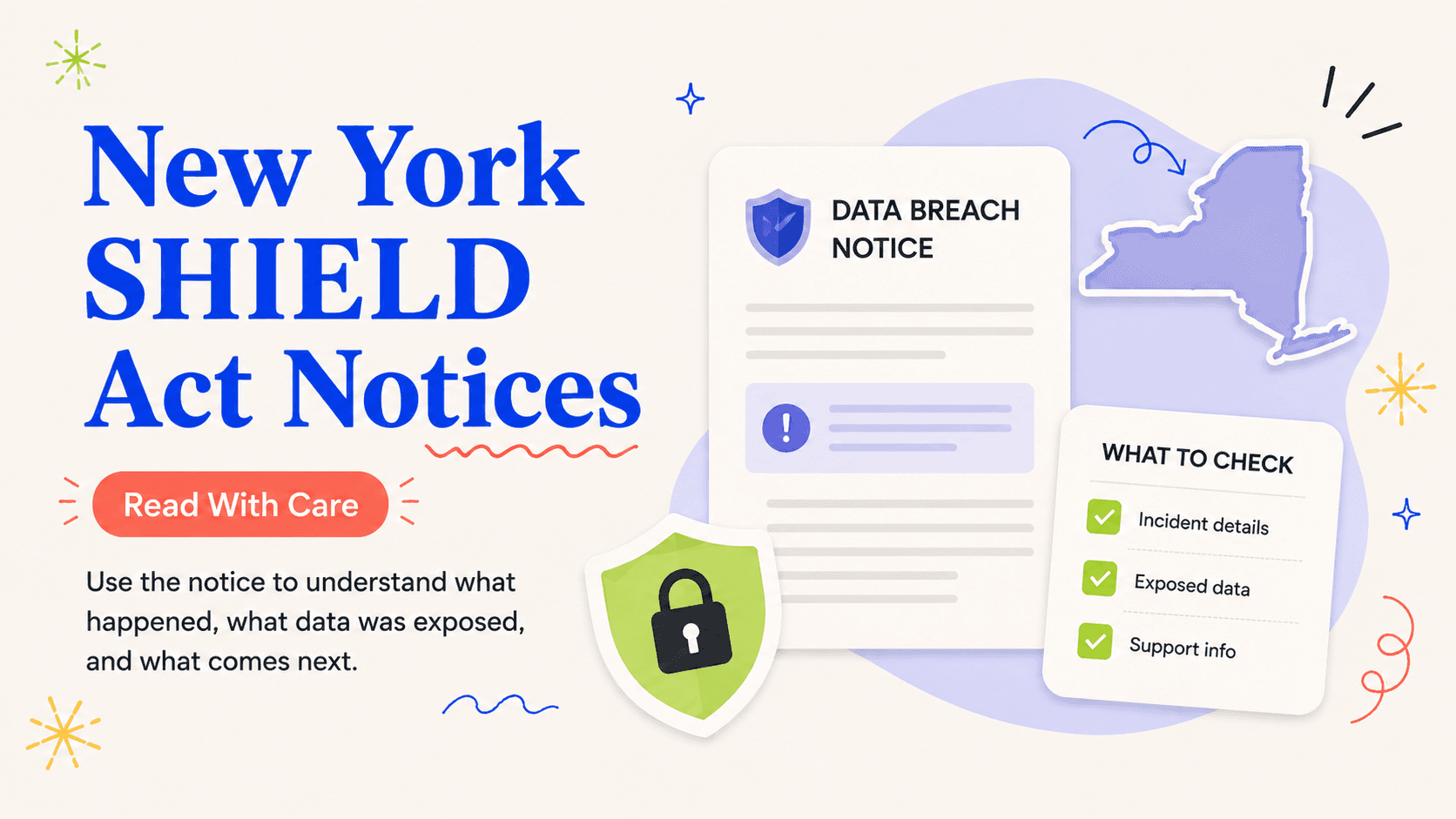
You live in New York and receive a breach notice that says data was accessed but not necessarily downloaded.
The SHIELD Act broadened New York’s breach framework
The New York Attorney General explains that the SHIELD Act expanded the definition of a security breach beyond unauthorized acquisition to include certain unauthorized access to computerized data that compromises private information. That distinction helps explain why a notice may be required even when a company cannot show that files were downloaded.
For consumers, the safest approach is to focus on the data categories named in the notice rather than trying to interpret forensic terms on your own.
Notice timing is tied to discovery and law-enforcement needs
New York’s guidance says affected consumers must be notified after discovery of a covered breach in the most expedient time possible, consistent with legitimate law-enforcement needs. The organization also has state reporting obligations.
That legal timing does not create a waiting period for you. Once you know sensitive information was exposed, take the protective steps that match the information.
Use the Attorney General complaint route as a consumer
The New York Attorney General’s data-breach pages separate the organization reporting portal from the consumer complaint process. If you are an affected consumer, use the consumer complaint route rather than trying to file the company’s breach notification.
Save your notice and any supporting documents before submitting a complaint so you can describe the issue accurately.
Substitute notice does not mean your data is less important
The Attorney General describes circumstances in which a business can use substitute notice, such as very large affected populations, very high notice cost, or insufficient contact information. That may involve email, website posting, and statewide media.
If you learn of an incident through a public notice rather than a personalized letter, verify whether your data is actually involved before sending sensitive information to anyone who contacts you about it.
Use legal sources for rights, response sources for actions
State law tells you what organizations must do. FTC, CFPB, IRS, SSA, and the credit bureaus explain many of the recovery tools a person uses afterward. Keep those roles separate so a legal notice page does not become a substitute for a practical recovery plan.
For questions about damages, litigation, or whether a particular organization violated the SHIELD Act, consult a qualified New York attorney.
Pay attention to notices based on access, not only confirmed acquisition
Because New York’s SHIELD Act guidance discusses unauthorized access as well as acquisition in its breach framework, a company may notify you even when it cannot say data was downloaded or used. That uncertainty is common in incident investigations. Respond to the sensitivity of the data, not to whether the letter can prove a thief already exploited it.
A notice involving online credentials can call for password changes immediately, while an SSN exposure can justify freezes and longer-term monitoring even if no misuse is visible.
Check the state’s official reporting page for updates
The New York Attorney General maintains a data-breach reporting section and SHIELD Act guidance. Use those pages when you need the current state process or complaint route. Third-party law summaries can become stale after amendments or policy changes.
Save a dated copy or note of the guidance you relied on if you are documenting a time-sensitive dispute.
Substitute notice changes delivery, not the sensitivity of the incident
When a company uses substitute notice under the circumstances described by the Attorney General, affected people may learn about the incident through a website, email, or media notice rather than a personalized letter. Verify whether your information was actually in the affected population before sharing identity documents with anyone who contacts you.
Once involvement is confirmed, follow the same data-specific response steps you would use after a mailed notice.
Example: a New York notice says data was accessed but not downloaded
Read the notice for the specific categories of private information and the period of unauthorized access. New York’s SHIELD Act guidance is important because it explains that covered breaches can involve unauthorized access, not only a proven download or acquisition. That means the absence of proof that files were copied should not be treated as proof that no response is needed.
Verify the organization’s incident information through its official site and the New York Attorney General’s data-breach resources. If the notice came through substitute methods rather than a personal letter, ask the organization through a verified channel whether your record was actually in the affected population. Do not provide identity documents to an unsolicited caller who claims to be confirming your eligibility.
Once involvement is verified, use the same data-specific controls you would use elsewhere: account security for credentials, freezes for identity data when appropriate, bank or card action for financial credentials, and medical-record review for health information. The SHIELD Act page explains the state framework; the recovery action still belongs with the systems where the exposed data can be abused.
- Focus on data categories, not only whether download was proven.
- Verify substitute notices independently.
- Use the Attorney General’s consumer complaint route when needed.
- Keep legal interpretation separate from recovery steps.
Use the state framework as context, not as a substitute for action
The SHIELD Act helps explain why a company may notify you after unauthorized access even when it cannot prove data was downloaded. Once the notice identifies the information involved, shift to the appropriate response system: bureaus for credit protection, banks for financial accounts, IRS for tax misuse, providers for medical records, and FTC for confirmed identity theft. Keep the New York notice and Attorney General materials as context for the incident while the recovery work proceeds elsewhere.
Save amended notices when the exposed-data list changes
If a company updates the incident after your first notice, save the updated page or second letter beside the original. A change in the list of affected data can change your response. For example, a later confirmation that online credentials or an SSN were involved may add account-security or credit-protection work that was not justified by the first notice.