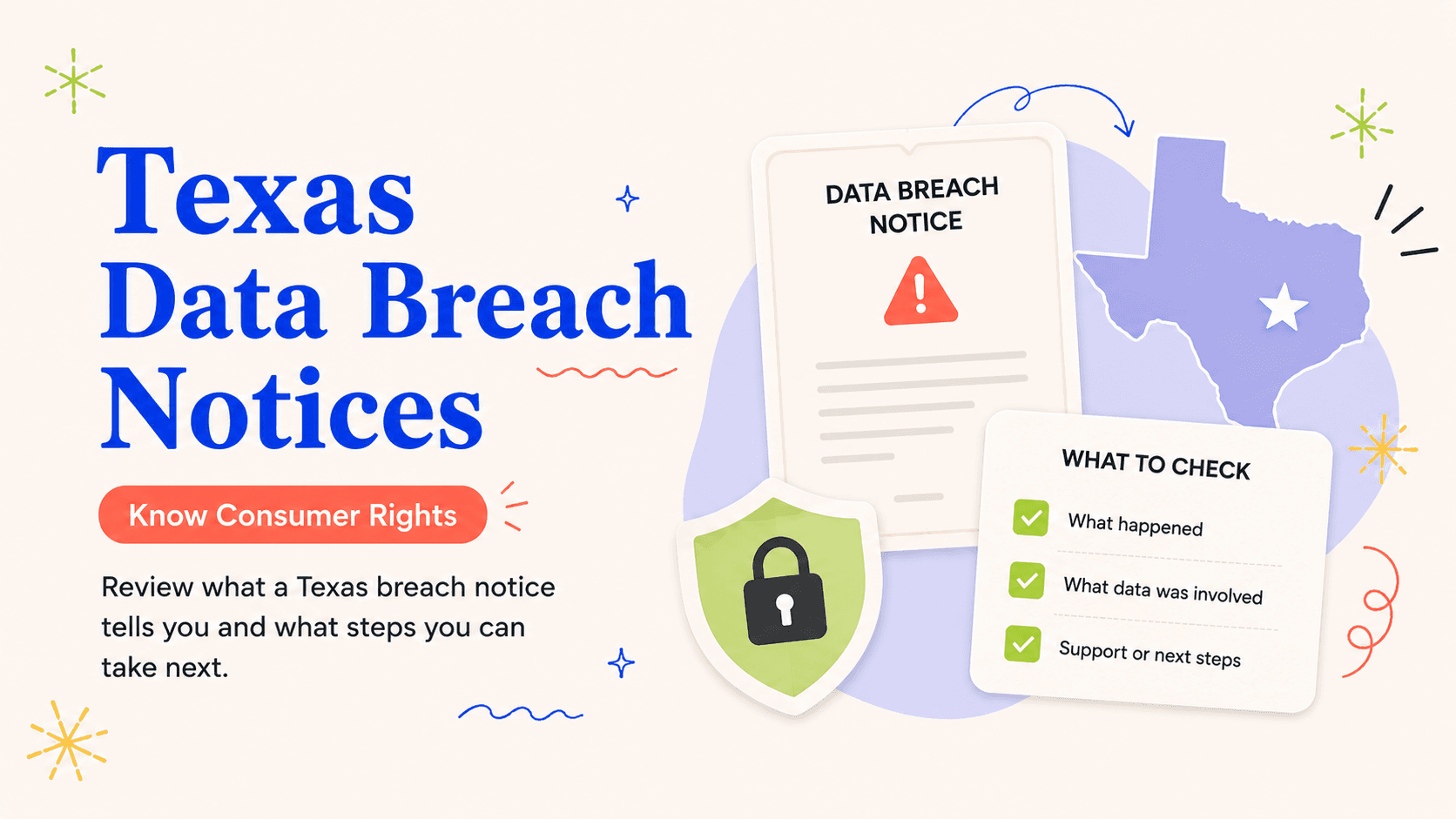
You receive a notice six weeks after a Texas breach and want to understand the state process.
Texas sets consumer-notice and Attorney General reporting duties
The Texas Attorney General’s current overview says affected individuals must receive timely notice no later than 60 days after the business determines a qualifying breach occurred. It also says breaches affecting 250 or more Texans must be reported to the Attorney General as soon as practicable and no later than 30 days after discovery.
Those are obligations on the organization. They do not mean you should wait 30 or 60 days before freezing credit or securing an account after you receive a notice.
Check the official breach-report list
The Texas Attorney General provides a list of data breach reports it has received. If the incident meets the state reporting threshold, the list can help confirm that the organization reported it and may show the types of information involved and how many Texans were notified.
Use the official site rather than a reposted breach tracker when you need the state’s own record.
Read the notice for your specific data types
Texas’s law covers categories of sensitive personal information, but your response still needs to be personal. Highlight exactly what the notice says about your SSN, driver’s license, financial account, or health information and follow the workflow for that data type.
A generic “take precautions” paragraph is less useful than the incident-specific data list.
Consumers should not use the business reporting form
The Attorney General’s site says the electronic Data Breach Report is for authorized representatives of businesses and organizations. Consumers who received a notice or have information about a breach should use the consumer complaint form instead.
This distinction prevents you from entering personal information into a form designed for corporate reporting.
Keep legal interpretation separate from response steps
The Texas Attorney General states that its overview is informational and that the office cannot provide legal advice to private individuals. If you are deciding whether a notice complied with law or whether you have a legal claim, that is different from carrying out the immediate identity-protection steps described on this site.
Use the state page to verify the administrative framework, then act on the data exposure itself.
Understand what the 250-person threshold means
The Texas Attorney General reporting threshold described on the official site concerns the organization’s duty to report a breach affecting 250 or more Texans to the Attorney General. It does not mean a breach affecting fewer people is harmless or that an individual loses the need to respond. Consumer notice obligations and your personal security actions are separate questions.
Use the state threshold only to understand why an incident may or may not appear in the Attorney General’s public reporting system.
Compare the notice date with the organization’s determination date carefully
Texas guidance describes timing from the organization’s determination that a breach occurred. A consumer usually does not know that internal determination date from the outside. The public report or notice may provide some timeline details, but avoid assuming the first suspicious network event is legally identical to the determination date.
If notice timing itself is your concern, preserve the letter, envelope, email headers, and public incident page before making a complaint or seeking legal advice.
Use the Attorney General list to verify, then return to the affected account
The state breach list can confirm that a report exists and provide high-level incident information. It cannot tell you whether an unauthorized bank transfer should be reversed, whether a credit file should be blocked, or whether your tax account was used. Those actions belong with the bank, bureaus, FTC, IRS, or other institution involved.
Treat the state resource as one layer of evidence in a broader response file.
Example: verifying a Texas breach report and notice timeline
Imagine a Texas employer sends a notice that your SSN was involved. Open the Texas Attorney General’s data-breach reporting site and search the public reports for the organization if the incident appears large enough to meet the state reporting threshold. Compare the breach description, the approximate number of Texans notified, the report date, and the information categories with your letter.
Do not infer legal conclusions from a simple date comparison. The Texas timing rules described by the Attorney General use the organization’s determination or discovery points, which may not be the first date of malicious activity shown in a forensic timeline. If you believe the notice was deficient, preserve the envelope, email, and public report and use the Attorney General’s consumer complaint route or legal counsel for that issue.
At the same time, respond to the data. An SSN exposure can justify credit freezes and IRS or SSA follow-up; bank data calls for bank action; credentials call for password and account-security work. The state report is an administrative verification layer, not a waiting room for the security steps that can protect you now.
- Check the Texas public breach list when applicable.
- Do not use the business submission form as a consumer.
- Preserve notice dates and delivery evidence.
- Keep state-law questions separate from immediate response actions.
Document any timing concern before it becomes a legal question
If you believe the notice arrived unusually late, save the envelope, email headers, public Attorney General report, company incident page, and any dated customer-service response. Those records are more useful than a screenshot of a third-party article. Continue the practical security response at the same time. If you later seek legal advice or submit a consumer complaint, you will have the timeline needed to explain the issue without relying on memory.
A missing Texas public report does not erase your personal risk
A small incident may still require a personal response even if it does not meet the threshold for an Attorney General report. Base your security actions on the information exposed and the notice you received. The public list is useful for verification, but it is not a complete catalog of every event that could affect one Texas consumer.