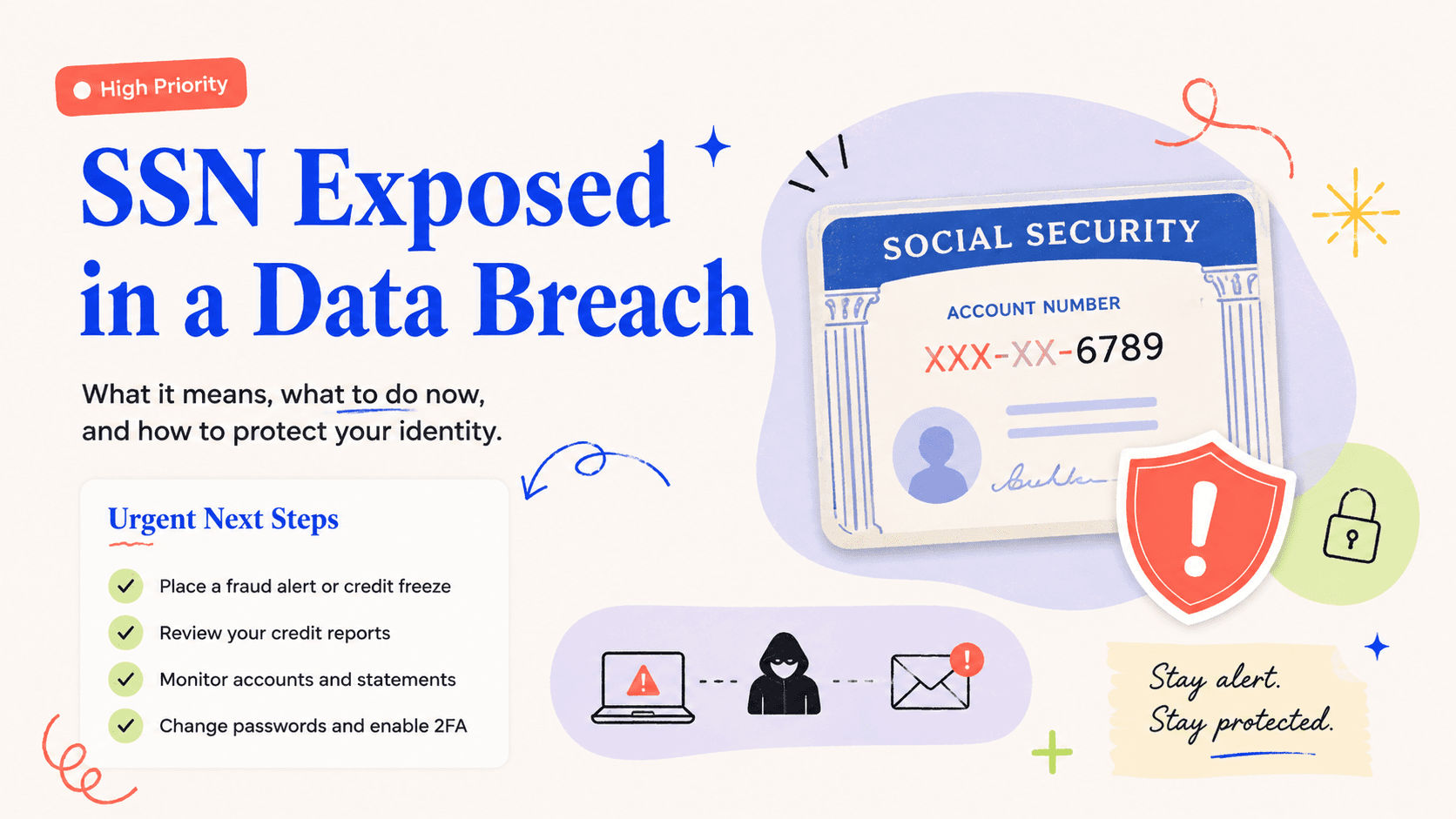
A breach notice says your Social Security number was included, but you have not yet seen any unauthorized account or tax problem.
Understand what makes an SSN exposure different
A Social Security number is not a payment credential that you can simply cancel and reissue after every incident. It is used across tax, employment, credit, and government records. That means the response is less about one replacement action and more about placing barriers around the systems where the number could be misused.
An exposure also does not mean misuse has already happened. The practical goal is to make common forms of misuse harder, establish clean baselines in your records, and know which signals would justify a formal identity-theft report.
Freeze all three credit files for new-account risk
The FTC describes a credit freeze as a strong tool against an identity thief opening new credit in your name. Freezes are free, remain until you lift them, and must be placed with Equifax, Experian, and TransUnion separately. Save each confirmation because you may need to manage the freeze later when applying for legitimate credit.
A freeze does not stop every use of an SSN. It will not repair a false tax return, remove fraudulent earnings from a Social Security record, or stop activity on an already-open bank account. It is one barrier aimed primarily at new-credit access.
Review credit reports and Social Security earnings separately
Pull your credit reports from AnnualCreditReport.com and look for unfamiliar accounts, addresses, and inquiries. Separately, review the earnings posted to your Social Security record. The SSA specifically advises people who believe someone is using their SSN to check their earnings record and report inconsistencies.
These records answer different questions. A clean credit report does not prove that the SSN has not been used for employment or tax-related fraud, and an accurate earnings history does not rule out credit misuse.
Consider an IRS IP PIN for tax-return protection
The IRS offers an Identity Protection PIN, a six-digit number used to verify a taxpayer’s identity on federal tax returns. The IRS says anyone with an SSN or ITIN who can verify identity is eligible to enroll, and a new IP PIN is generated each year.
An IP PIN is not a general identity-theft password. It protects federal tax filing. Keep it separate from normal account credentials and share it only when needed for filing with the IRS or a trusted tax professional.
Use IdentityTheft.gov if the exposure turns into actual misuse
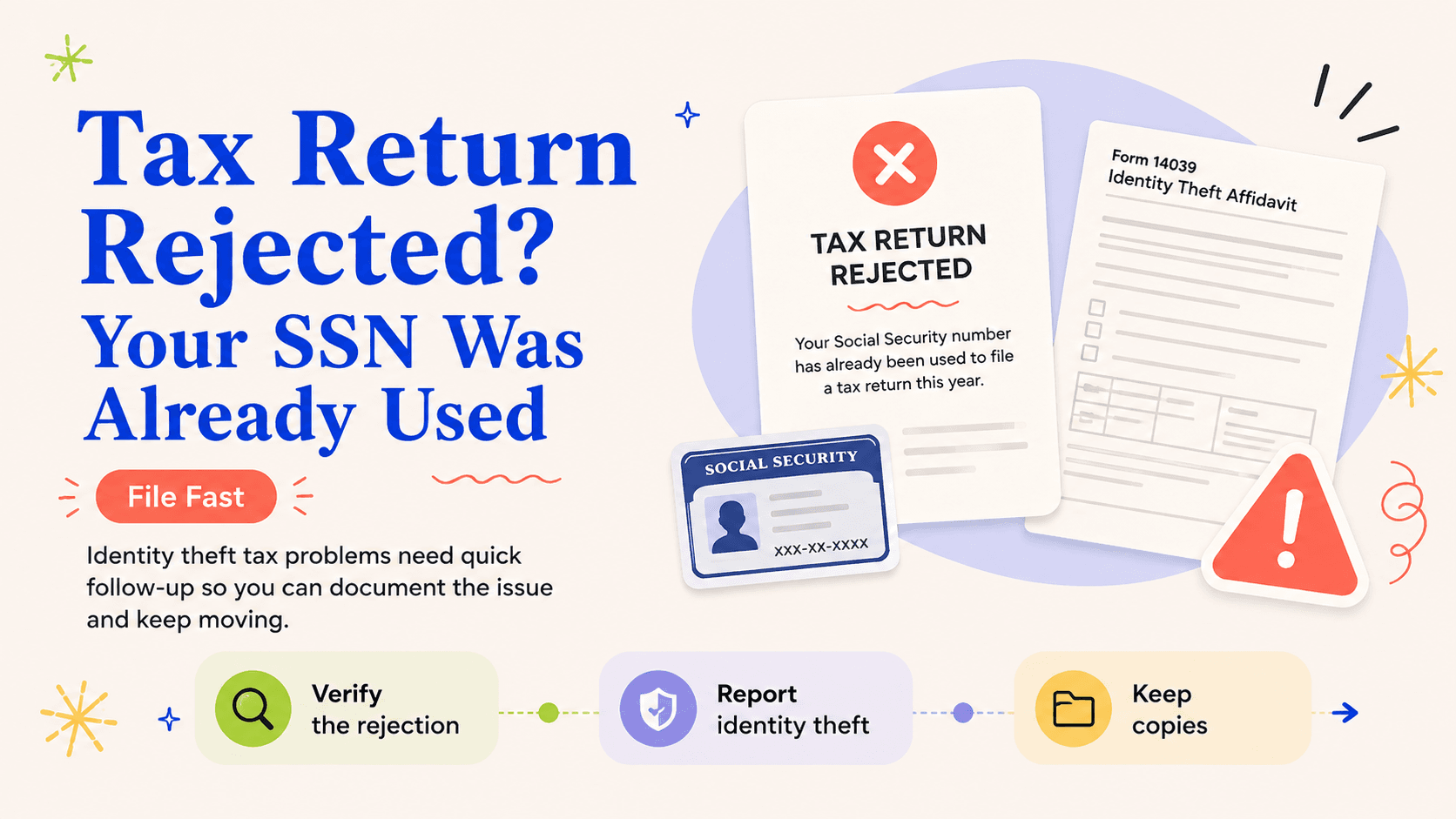
If you later discover a credit account, tax filing, benefit claim, or other transaction made using your identity, report the actual identity theft at IdentityTheft.gov. The system can generate an FTC Identity Theft Report and a recovery plan tailored to what happened.
Keep the original breach notice with your later evidence. It may help explain how your information became exposed even though the formal recovery steps focus on the fraudulent activity itself.
Do not expect a credit freeze to cover tax, employment, or benefit misuse
A freeze is powerful for the problem it addresses: access to a credit file for many new-account decisions. It does not turn the Social Security number off. Someone may try to use an SSN in systems that do not rely on a standard credit pull, which is why the response also includes IRS and Social Security records when appropriate. Keeping those domains separate reduces the chance that a clean credit report gives you false reassurance.
Review your financial accounts as well. An SSN breach can be combined with other leaked information from unrelated incidents to impersonate you at an existing institution. The best response assumes that identity data can be assembled across sources rather than treating the breached company as the only place an attacker has information.
Create a durable incident file for a durable identifier
Keep the notice, credit-freeze confirmations, report copies, FTC report if one is created, IRS correspondence, and Social Security correction records in one secure folder. Use filenames that contain dates and the organization involved. If misuse appears a year later, you will be able to reconstruct the sequence without searching several email accounts.
Do not place the full SSN in the folder name, a spreadsheet label, or a shared cloud note. The incident record should help you manage the exposure without unnecessarily reproducing the sensitive identifier.
Use periodic checks rather than constant panic
Long-term monitoring does not mean checking every account every hour. Choose a sustainable routine: transaction alerts on financial accounts, periodic credit-report review, an annual or event-driven check of Social Security earnings, and tax-account attention around filing season. If you enroll in an IRS IP PIN, retrieve and store the current year’s number securely when needed.
Escalate when a concrete signal appears—an unfamiliar account, tax notice, benefit problem, debt collection contact, or earnings discrepancy. A structured monitoring plan is more effective than repeatedly searching the web for whether the breached dataset has been posted somewhere.
A practical 90-day SSN response plan
During the first week, place freezes with all three nationwide credit bureaus, save the confirmations, pull the three reports, and secure the email, financial, and tax accounts that could be used with the exposed identity information. If the breached company offers monitoring, verify the enrollment through its official incident page and treat the service as an alert layer rather than as a replacement for the freezes.
During the following month, review your Social Security earnings record and IRS account access if those checks fit your situation. Consider an IRS IP PIN for future tax filings. Keep your breach notice and a dated copy of each credit report. If a new account, collection, tax notice, or unfamiliar earnings item appears, move from preventive response into the specific recovery process for that system rather than simply increasing the frequency of monitoring.
By the end of roughly three months, the response should be sustainable. Credit files remain frozen unless you need a temporary lift, financial accounts have transaction alerts, and you have a calendar reminder for periodic credit and government-record reviews. The objective is not to watch the SSN continuously; it is to keep durable protections in place and know exactly what evidence would trigger a formal identity-theft report.
- Keep the full SSN out of filenames and tracking sheets.
- Store freeze credentials in a secure password manager.
- Use IRS.gov and SSA.gov directly for government-account checks.
- Preserve every notice or case number tied to actual misuse.