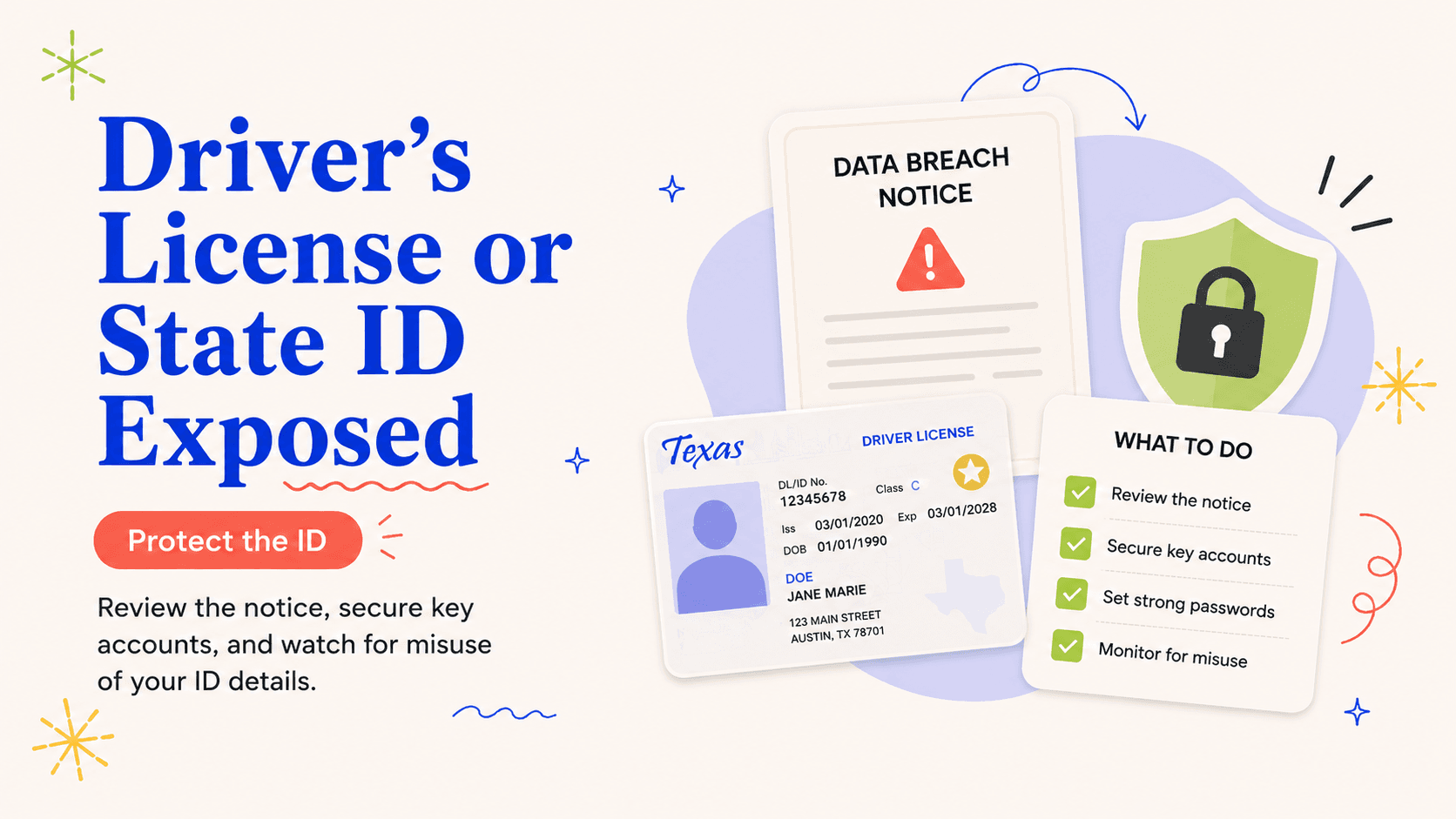
A breach letter says your name and driver’s license number were accessed, but your physical license is still in your wallet and you have not seen a fraudulent account.
What an exposed license number can and cannot prove
Start by treating an exposed driver’s license or state ID number as a specific response problem rather than as proof that every part of your identity has been taken over. The number can be used as an identity-verification element, but exposure alone does not show that a loan, phone account, or other product has already been opened. Check the breach letter for the exact identifier involved and confirm whether the physical card was also lost, stolen, or copied.
Hold onto the notice first, note when it arrived, and record the exact data element or account it names before reaching out to anyone. If the card is still with you, avoid assuming every state automatically requires a replacement; replacement and fraud-flag procedures differ by issuing agency.
A license-number breach and a stolen wallet are different incidents. If the card never left your possession, record that fact because it changes what the issuing agency may recommend. If the physical credential is missing too, say so when you contact the DMV or licensing office; the agency can then apply the process for a lost or stolen document rather than treating the issue as a number-only exposure.
Start with the credential that actually exists
The first move should reduce the most immediate pathway to misuse. Secure any account that used the exposed license number together with a password, PIN, or other credential, then check the issuing DMV or licensing agency through its official site.
Tackling every possible outcome simultaneously rarely works — sequence the response instead. If the physical card is missing, that is a separate and more urgent fact because the card itself can be presented as an identity document.
Do not assume that ordering a replacement card automatically creates a new identifier. States control their own licensing systems, and replacement practices are not uniform. Use the official state agency site to learn whether the number can change, whether a fraud note is available, and what evidence the agency wants. That is more reliable than a breach vendor making a nationwide promise about a state-issued credential.
Use the issuing agency, not a random replacement link
The state DMV or equivalent issuing agency is the place to confirm whether it recommends replacement, a new number, a record flag, or another state-specific step.
If anyone asks for identity documents mid-process, verify the request is legitimate before sending anything. If a breach company offers help, compare its instructions with the state agency’s own published process before sending a copy of your license.
If the breach also included a Social Security number, birth date, or other identity data, the license number may become more useful in a fraudulent application. In that combination, a credit freeze and careful report review can reduce new-account risk. A freeze does not, however, prevent someone from presenting copied ID information to a business that does not use a consumer credit report.
Decide whether credit controls fit the exposure
A credit freeze only earns its place here if the exposed data could actually be used to open new credit. A freeze can make new-credit fraud harder when the license number is combined with other identity data, but it does not stop every non-credit use of an ID number.
When credit monitoring applies here, start with a dated baseline report from annualcreditreport.com before watching for changes. Pay particular attention to unfamiliar inquiries and newly opened accounts that could indicate the identifier was used in an application.
Build a record before a fraudulent application appears
Good records aren't a side task here — they're part of actually resolving this. Keep the original breach notice and note the license number only in masked form in your incident log so the log itself does not become another exposed copy.
Once misuse is actually confirmed, the situation moves out of breach response and into identity-theft recovery. If an account or transaction appears that you did not authorize, report the identity theft at IdentityTheft.gov and follow the recovery steps for that specific company.
Keep the credential itself out of your incident log. A masked notation such as the last four characters, the issuing state, and expiration year is usually enough to identify which document was exposed. Store any scan you must provide through the agency's verified upload process rather than scattering full license images across email, cloud notes, and support chats.
Do not confuse a new card with complete protection
One control rarely fixes every consequence of a case like this. Replacing a plastic card does not necessarily erase copies of the old number already held by businesses or attackers, while a credit freeze does not secure an existing bank login.
Also separate exposure from confirmed misuse. An unfamiliar application, debt, or government notice is stronger evidence of misuse than the breach notice by itself.
Watch for fake DMV and identity-support messages
Expect follow-up scams that reference the exposed number. Messages claiming the DMV needs an immediate fee, cryptocurrency payment, gift card, or one-time code should be treated as suspicious and checked independently.
A legitimate recovery process should be verifiable through an established channel. Type the agency address yourself or use a known government bookmark rather than a shortened URL from a text message.
Set checkpoints for later misuse
Finish the initial response by putting specific follow-up dates on a calendar instead of relying on memory. Review credit reports after the breach and again if you later receive an unexpected lender, carrier, insurer, or government notice.
You should be able to state whether the physical credential was affected, what the issuer told you, and what evidence would trigger a formal identity-theft report.
Future warning signs are application-shaped: a lender verification call you did not expect, a wireless account, an unfamiliar hard inquiry, or mail about an account you never opened. If one appears, document the company and date before disputing it. That turns a general breach concern into a specific identity-theft event that can be reported and corrected through the organization involved.