You live in New Jersey, received a breach letter, and are trying to work out whether the company was late and who else was told before you were.
No countdown clock — a standard instead
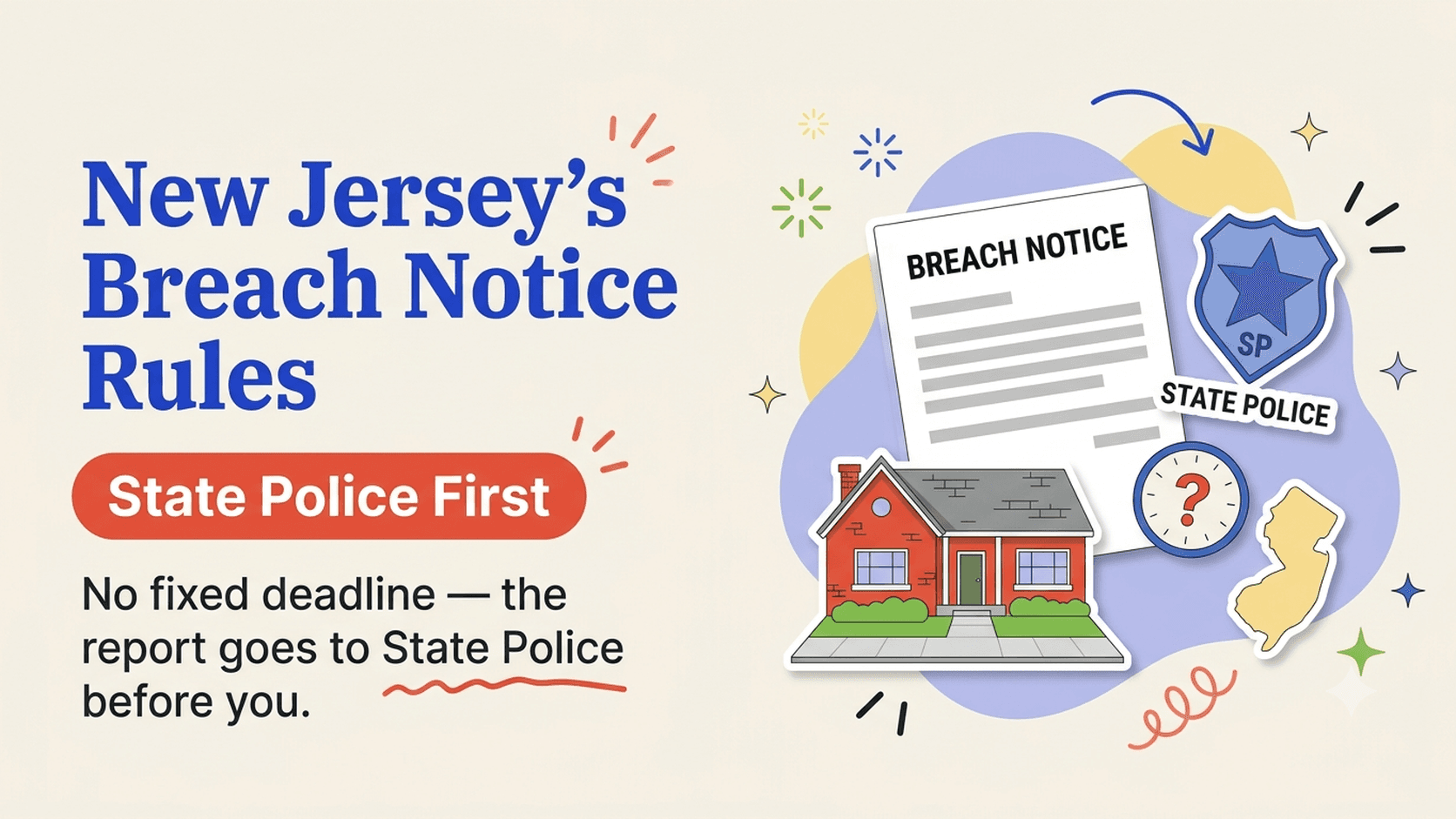
Most states hand you a number: 30 days, 45 days, 60 days from discovery. New Jersey does not. Its law requires disclosure “in the most expedient time possible and without unreasonable delay,” which is a standard a court or regulator applies case by case rather than a deadline you can check a calendar against.
That makes a New Jersey letter harder to judge on timing alone. A letter arriving six weeks after a breach was discovered is not automatically late, and one arriving in two weeks is not automatically fine — what matters is whether the delay was reasonable given the time needed to investigate scope, restore systems, and work with law enforcement.
State Police first, not the Attorney General
New Jersey's routing is unusual. Before any business notifies affected residents, it must first report the breach to the New Jersey Division of State Police in the Department of Law and Public Safety.
That is different from states like California or North Carolina, where the Attorney General is the pre-disclosure recipient and often the source of a public breach list. New Jersey's Attorney General, through the Division of Consumer Affairs, plays an enforcement role after the fact under the state's Consumer Fraud Act rather than being the first call — so there is no equivalent AG breach registry you can search the way you can in some other states.
The exemption a company can use to send no letter at all
New Jersey law lets a business skip notifying you if it determines, in good faith, that misuse of the exposed information is not reasonably possible. That determination has to be made in writing and kept on file for five years — it is not a casual judgment call, but it does mean some incidents legally produce silence.
If you separately learn your data may have been involved in an incident and never receive a letter, that no-misuse-likely determination is one explanation. Asking the company directly whether it made and documented that finding is a reasonable question to put to them.
The encryption safe harbor
New Jersey also exempts properly encrypted data from the notification requirement, as long as the encryption key itself was not also compromised in the same incident. A letter that mentions your data was encrypted, and that the key was not exposed, is telling you the company believes it fits inside this exemption — and chose to notify anyway, which some companies do out of caution even when the law would not require it.
What counts as protected information
New Jersey's definition covers your name paired with a Social Security number, driver license or state ID number, or a financial account, credit, or debit card number combined with any required security code, access code, or password. A 2019 amendment broadened the list to include a username or email address paired with a password or security question and answer that would permit access to an online account — so an account-credential exposure alone, without a financial number, can still trigger notice.
Your response does not wait on the company's deadline
Because New Jersey has no fixed clock, waiting to see “how long they're allowed to take” is not a useful strategy. The moment you learn your data was exposed — by letter or otherwise — secure the affected login, check the account or accounts named in the letter, and freeze your credit at all three bureaus if a Social Security number or account number was involved. None of those steps depend on New Jersey's notification standard.
If you suspect a breach but never got a letter
Contact the company through a verified number or its official site and ask directly whether your information was involved, and whether it determined that misuse was not reasonably possible. You do not need their confirmation to act — you can request your own credit reports and place a freeze regardless of what the company decides about its own notice obligation.
A letter that took two months to arrive
A retailer you shopped with in New Jersey discloses, in a letter dated late spring, that it discovered unauthorized access to its payment system in early winter. Two months is a long gap, and your first instinct is that this violates the law.
Under New Jersey's standard, that gap is not automatically a violation — the question is whether the time was spent reasonably on investigation, containment, and coordination with the Division of State Police, or whether it reflects unreasonable delay. You are not in a position to make that legal determination yourself, but you can still act immediately: check your card statements for the months since the incident, and if a card number was exposed, ask your bank to reissue the card and dispute anything unfamiliar.
How New Jersey compares to its neighbors
New York's SHIELD Act and Pennsylvania's breach law both give affected residents a somewhat easier timing question to answer than New Jersey does, because neither uses a bare “without unreasonable delay” standard the way New Jersey does for its core requirement — though New York also avoids a fixed day count for the same reason. If you live near the New Jersey border and receive breach letters from companies operating across state lines, don't assume the same clock applies to each state's version of the notice; each state's own statute governs the version sent to its own residents, even from the same company and the same incident.
New Jersey is also one of the few states that routes its pre-disclosure report to a law enforcement agency rather than a consumer-protection regulator, which is why you won't find a New Jersey breach registry the way California and North Carolina each publish one — there's no equivalent public list to check for New Jersey.
Frequently asked questions about New Jersey breach notices
- Can I file a complaint if I think a company took too long? Yes — the New Jersey Division of Consumer Affairs handles complaints under the Consumer Fraud Act, though “unreasonable delay” is judged case by case rather than against a fixed number of days.
- Does New Jersey require free credit monitoring after a breach? No — New Jersey's breach statute governs the notice itself, not what remedy, if any, a company must offer; any monitoring offer in your letter is the company's own choice, not a state mandate.
- What if the breach happened at a company based outside New Jersey? New Jersey's law protects New Jersey residents regardless of where the breached company is headquartered, so an out-of-state company still owes you a notice under this state's standard if you live here.
- Is there a New Jersey-specific breach look-up tool? No public breach registry exists for New Jersey the way it does in a few other states, since the pre-disclosure report goes to State Police rather than to an office that publishes a public list.
Keep the letter and note the discovery date
File the notice with the date it says the breach was discovered and the date the letter itself is dated — that gap is the fact that matters if you ever need to raise a complaint with the Division of Consumer Affairs, even though New Jersey's own standard does not give you a specific number of days to point to.