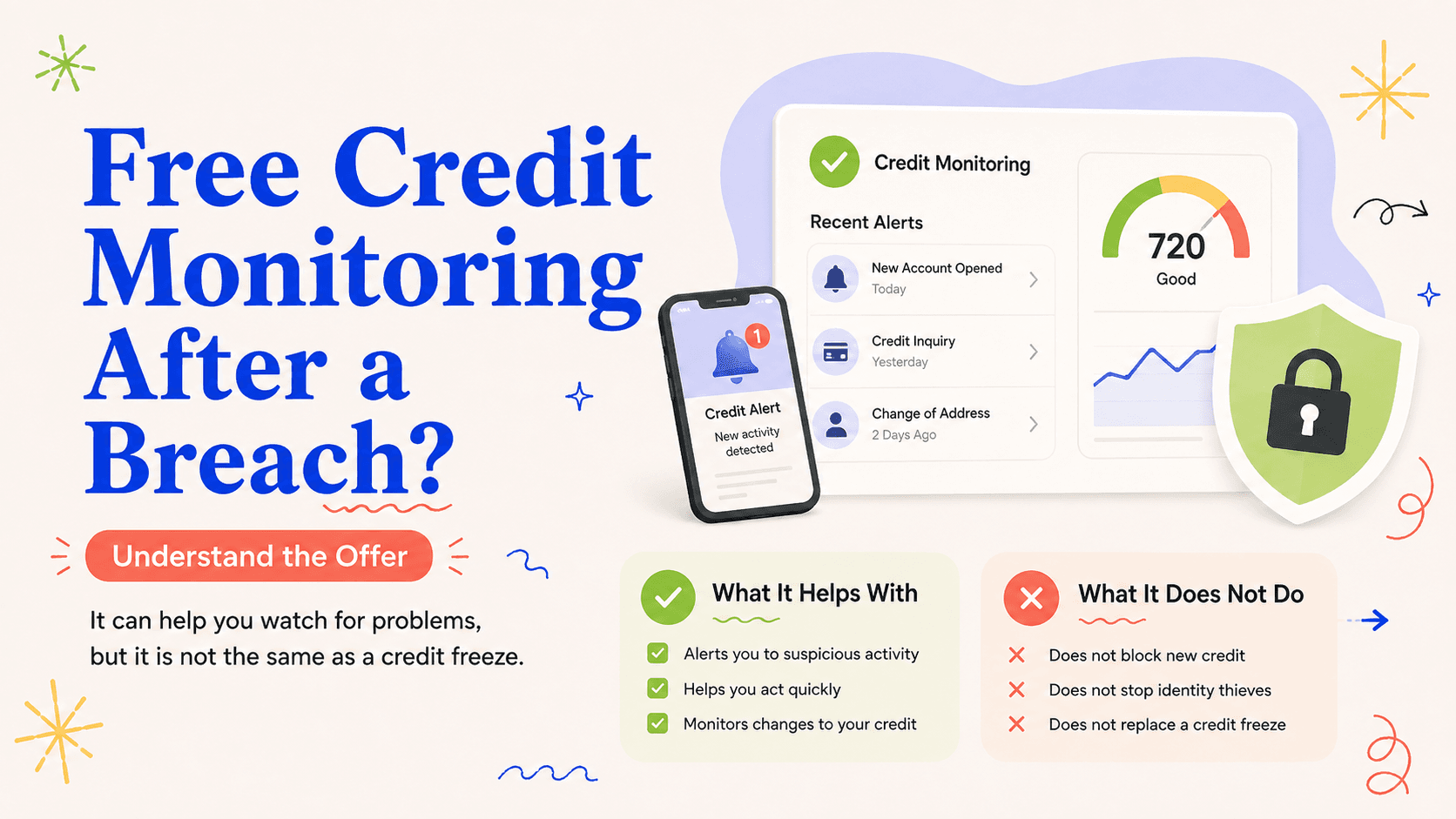
A company offers 24 months of monitoring after exposing your Social Security number.
Confirm the offer through the company’s official incident page
Record the provider, enrollment deadline, activation code, and eligibility terms from the breach notice. Then verify those details through a known company website or customer-service channel before entering personal information.
Breaches often attract phishing messages that imitate the real offer, so verification is part of enrollment.
Read what the service actually monitors
Some services watch one bureau; others watch three. Some add identity-restoration assistance or insurance. Check which data sources generate alerts and how long coverage lasts. An impressive product name does not tell you what is being monitored.
Save the terms you enrolled under so you can compare later if the provider changes features.
Do not confuse detection with prevention
Monitoring can notify you after a new account, inquiry, or other report change appears. A credit freeze restricts access to the credit file used for many new-credit decisions. The FTC describes them as different tools.
If an SSN was exposed and you do not need immediate new credit, you can consider monitoring as an alert layer while using freezes for stronger new-account protection.
A free offer should not require you to pay to place a freeze
Credit freezes are free to place and lift. An enrollment page may offer paid upgrades, but you do not need to buy a monitoring subscription to exercise your freeze rights.
Be cautious if a service asks for a payment card before clearly explaining whether a free period automatically converts to a paid plan.
Plan for the end of the monitoring period
Set a calendar note for the coverage end date and review whether you still want a paid service before any automatic renewal. Your credit freeze, if you placed one, does not expire merely because the monitoring offer ends.
Continue checking official credit reports and your financial accounts based on the risk that remains.
Check whether monitoring covers one bureau or all three
An alert from one bureau cannot show an account that appears only on another bureau’s file. Read the service description to see which reports are monitored, how often alerts are generated, and whether the service also watches non-credit identity data. The word “credit monitoring” by itself does not guarantee three-bureau coverage.
Even with three-bureau monitoring, continue to review your own reports when a high-risk identifier such as an SSN was exposed. Monitoring is an alert service, not a substitute for understanding what is on the file.
Read restoration and insurance terms separately from monitoring
Some breach packages bundle credit alerts with identity-restoration support or an insurance benefit. Those features have their own definitions, limits, exclusions, and claim procedures. If they matter to you, save the terms in effect when you enroll and note the support number.
Do not assume the presence of insurance means every financial loss will be reimbursed. Use the contract and provider materials for the actual scope.
Avoid creating a new subscription problem at renewal
Record whether the free offer ends automatically or converts to a paid service. If a card is requested, find the renewal price and cancellation process before enrolling. A legitimate free monitoring offer should not distract from the immediate security steps that do not require a subscription.
Set the cancellation or review reminder well before the free period ends. Your decision at renewal can be based on the risk that remains, not on an unexpected charge.
How to evaluate the offer in ten minutes
First verify that the offer is real. Go to the breached organization’s official incident page and confirm the monitoring provider, enrollment domain, code format, and deadline. If the notice came by email, do not use its link until those details match. Then read the monitoring description and identify whether it covers one bureau or all three, what types of alerts it sends, and how long the free term lasts.
Second, look for bundled features such as restoration support or insurance and read those terms separately. Note whether a payment card is required, whether the plan renews automatically, what the post-free price is, and how cancellation works. Save the terms in effect when you enroll. If the offer is truly free but the page pushes a paid upgrade, remember that the upgrade is optional and unrelated to your right to place a free credit freeze.
Third, decide what the service does not replace. If an SSN was exposed, you may still want freezes. If a bank login was compromised, you still need to secure the bank. If an identity thief already opened an account, you still need the FTC and creditor recovery process. Monitoring is useful when you treat it as an alert layer inside the larger plan rather than the plan itself.
- Verify provider and enrollment domain.
- Check one-bureau vs three-bureau coverage.
- Read restoration and insurance terms.
- Record the free-term end date and renewal price.
- Keep freeze and account-security steps separate.
Decide what you will do when the free term ends
Put the monitoring expiration date on your calendar when you enroll, not two years later when a charge appears. Before the free term ends, review whether the service is still useful, whether a paid renewal is worth it, and whether your freezes, report-review routine, and account alerts already provide the protections you need. If you cancel, save the confirmation. Ending a monitoring subscription does not remove a credit freeze, and keeping a freeze does not require paying the monitoring provider.
Save enrollment and restoration details with the incident record
Keep the enrollment confirmation and any identity-restoration contact information in your incident folder. If an alert appears months later, you should be able to tell whether it came from the breach-sponsored service, your bank, or another source and know which recovery channel to use without searching through old marketing emails.